SHARE THE NEWS
News and Updates on the 100-Day Challenges
Let’s spread the word about the great work done throughout the 100-Day Challenge journey.
For any media or content requests, please get in touch with us at Social@theworldofimpact.org
View our Latest Blogs
How is a 100-Day Challenge different from a normal project
Many institutions and organisations already run projects that aim to...
Read MoreWho is usually on a 100-Day Challenge team?
A 100-Day Challenge team is often described as a “dream...
Read MoreWhat happens at a 100-Day Challenge Start-up Workshop?
The Start-up Workshop is where the 100-Day Challenge team comes...
Read MoreThe City of Johannesburg’s 100-Day Challenge: A Community-Led Approach to Safety
In 100 days, the Braamfischerville GBVF Action Team of the...
Read MoreWinnie Mandela Regional Court: Coordinating across distance to improve case flow
In 100 days, the Rapid Response Team at Winnie Mandela...
Read MoreWaterberg District Municipality: When the Distance is the Problem, You Change How You Work
In 100 days, the Waterberg District Municipality team finalised 73.14%...
Read MoreGa-Kgapane Magistrate Court: Building stakeholder collaboration to reduce domestic violence case backlogs
The Ga-Kgapane Magistrate Court’s Buffalo Team entered the 100-Day Challenge...
Read MoreHealing the Wounds: Gert Sibande District Surpasses Counselling Target
The Department of Social Development (DSD) team for the Gert...
Read MoreWatch the Ending GBVF 100-Day Challenge Documentary
In the Media
Latest Press Releases
RELEASE DATE: 19 MAY 2026
A new cycle of Ending Gender-Based Violence and Femicide (GBVF) 100-Day Challenges is launching across South Africa, with local teams from Limpopo, Mpumalanga and Gauteng starting an intensive 100-Day implementation cycles focused on improving survivor outcomes within the justice, local governance and education sectors.
To launch their 100-Day projects, local teams such as courts, Technical and Vocational Education and Training (TVETs) and local municipalities will be hosting their Start-up Workshops bringing together frontline teams to set ambitious goals linked to specific GBVF impact areas within their institutions and communities.
This marks the fifth year of the national Ending GBVF 100-Day Challenge movement, which has become one of the country’s largest programmes for accelerating local action through focused collaboration, rapid implementation and continuous learning.
“This wave approximately builds on 360 previous Ending GBVF 100-Day Challenges organised since 2022, which have documented encouraging outcomes linked to survivor support, reporting systems, accountability processes and access to services,” shares Nomgqibelo Mdlalose, Movement Navigator for the programme.
Within the justice sector, courts participating in 2025 challenges recorded significant improvements in case management and survivor support. Thohoyandou Court finalised 889 of 1,039 cases, reaching an 86% clearance rate. Ga-Kgapane, Nkowankowa, and other teams eliminated all domestic violence and maintenance backlogs, directly reducing waiting periods for survivors seeking protection orders and maintenance support.
Local governance teams have also seen significant results linked to prevention, economic empowerment and reporting access. In the Eastern Cape, the Department of Social Development trained 70 survivors and provided complete starter packs that included sewing machines, laptops and workplace placements to support income generation opportunities. The King Sabata Dalindyebo Municipality partnered with the taxi industry to brand 100 taxis with GBVF prevention messaging while securing public pledges from taxi men. In Stellenbosch, teams established trauma rooms within police stations and introduced unmarked transport vehicles to improve survivor dignity and confidentiality. The West Rand challenge created three new reporting channels and increased case reporting by 30%.
Education sector teams focused strongly on reporting systems, peer support and accountability processes within campuses and colleges. Maluti TVET College reduced reported bullying by 78% and cyberbullying by 63%. Majuba TVET College trained 127 peer educators and increased formal GBVF case recordings from an average of four or five annually to 23 reported cases. West Coast College formalised 11 partnerships with SAPS, clinics and NGOs, while more than 13,000 students across participating institutions were reached through conversation-based engagements and awareness activities.
The 2026 cycle will continue focusing on practical barriers affecting survivors within local systems.
Justice sector teams will work on improving finalisation rates, reducing withdrawal rates, addressing case backlogs and strengthening the court experience for survivors navigating maintenance matters, protection orders and sexual offences processes. Local governance teams will focus on increasing access to referral pathways, strengthening reporting systems, linking vulnerable groups to economic opportunities and reducing GBVF incidents within identified hotspot areas. Education sector teams will focus on increasing reporting, improving support systems for survivors and strengthening accountability and deterrence mechanisms within institutions.
“The End GBVF 100-Day Challenges exist to accelerate lasting impact in our communities where we will see an enhanced capacity to address GBVF and hopefully a significant decrease in GBVF incidents,” adds Mdlalose. “They are designed to encourage multisectoral collaboration to localise the National Strategic Plan (NSP) to end GBVF.”
RELEASE DATE: 26 March 2026
More than 30 systems leaders from local municipalities and TVET colleges joined the first training cohort for the 2026 Ending Gender-based Violence and Femicide (GBVF) 100-Day Challenges on 17 to 18 March at Steve Tshwete Local Municipality in Mpumalanga.
The End GBVF 100-Day Challenges are locally led initiatives that drive rapid, results-oriented action primarily within three critical ecosystems: local government, education, and the justice cluster. Taking on these 100-Day Challenges, multi-stakeholder teams – which can include (but are not limited to) representatives from SAPS, NGOs, social workers, students and staff, traditional councils, local municipalities, and GBVF survivors – work towards bold, time-bound goals aligned with the National Strategic Plan on GBVF.
“The 100-Day Challenge model is designed to break the cycle of overplanning that holds institutions back from implementing. Teams set a time-bound, measurable goal, assemble their people and move. The 100-Day Challenge creates the conditions for rapid implementation, frontline innovation and collaboration among people that are closest to the problem, and where survivors and communities need it most,” says Nomgqibelo Mdlalose, Movement Navigator for the End GBVF 100-Day Challenges
2025: Consolidated impact across courts, municipalities and campuses
In Limpopo, participating court teams finalised over 1,600 domestic violence cases in 100 days, achieving an 86% reduction in their case backlog. Ga-Kgapane cleared all domestic violence backlogs by verifying addresses at filing. Nkowankowa eliminated all maintenance and domestic violence backlogs plus 80% of divorce cases through daily information sharing with SAPS.
Eastern Cape DSD trained 70 survivors with complete starter packs (sewing machines, laptops, workplace placements, cooperative linkages). Waterberg finalised 73% of cases using virtual coordination across vast distances. West Rand established 3 reporting channels and increased case reporting by 30% through mobile apps. Braamfischerville engaged 1,000+ residents with 25-volunteer patrols and survivor-led support circles. Drakenstein created a permanent GBVF Hub with child-friendly therapy rooms.
In the TVET sector, 69 campuses completed their End GBVF 100-Day Challenges. Majuba TVET College reached over 4,000 students and staff, trained 127 peer educators and 52 staff members, and recorded 23 formal GBVF reports through newly trusted reporting channels. Maluti TVET College reported that the number of students experiencing bullying dropped by 78% after targeted awareness sessions. Gert Sibande TVET College recorded a 27% increase in GBVF case reporting and a decrease in case withdrawals after implementing a rapid response protocol.
Steve Tshwete Local Municipality, the venue for this year’s first training, won the SALGA Award of Excellence in recognition of its GBVF work in partnership with the End GBVF 100-Day Challenge and UN Women in 2023 and 2024.
2026: Building the next generation of local GBVF responders
The leaders trained in the first cohort will now return to their communities to convene multi-stakeholder teams, select their area of focus aligned to the National Strategic Plan on GBVF, and launch their 100-Day Challenges on 18 May 2026. Importantly, these interventions will be designed to respond directly to the gaps highlighted in the NSP five-year review report, ensuring that local action is both targeted and responsive to where progress has been uneven or insufficient.This training cohort is the first of several planned for 2026 as the programme continues to expand.
“We are not asking teams to write another plan,” says Mdlalose. “We are asking them to set a survivor impact goal that feels almost impossible and then move on it with everything they have. The 100-Day Challenge exists because we cannot afford to wait for perfect conditions. What we can do is act, learn, adapt and deliver results that survivors can feel in 100 days.”
Building the Legacy - National Mobalisers
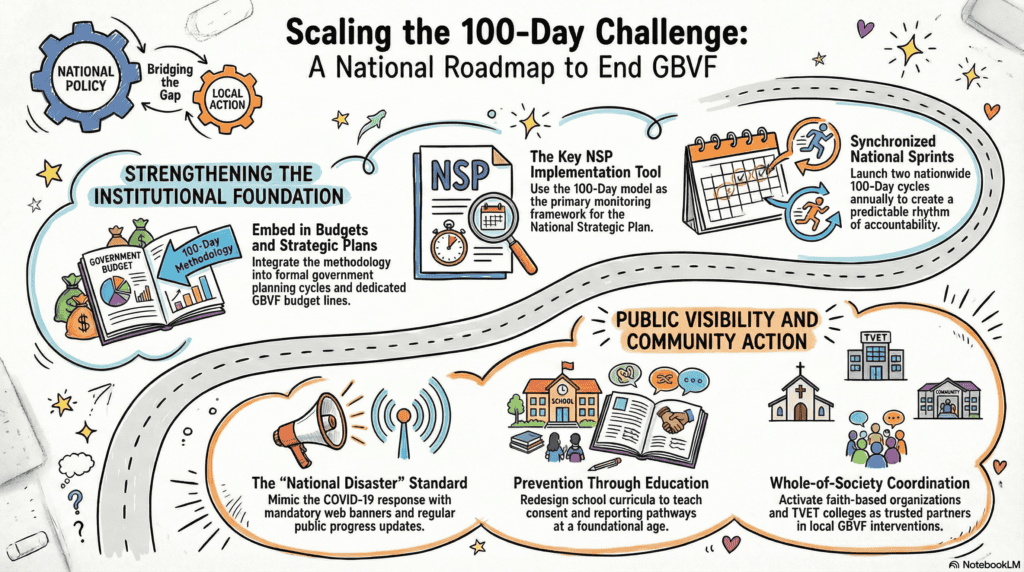
On 24 March 2026, a group of past 100-Day Challenge conveners, strategists and coaches gathered in a room with a single purpose: to map out how the Ending GBVF 100-Day Challenges model moves from a programme into standard practice across South Africa’s government, education and private sectors. These are the National Mobilisers. They have convened and run the sprints, gathered the lessons, and are now turning their experience into a growth plan for the Ending GBVF 100-Day Challenges.
The day produced five consolidated implementation themes, a set of practical scaling plans built on sticky notes and sharp conversation, and a set of personal commitments that sounded as serious as marriage vows.