100-day-challenge

The City of Johannesburg’s 100-Day Challenge: A Community-Led Approach to Safety

In 100 days, the Braamfischerville GBVF Action Team of the City of Johannesburg Department of Social Development reached over 1,000 residents across Region C and Region D, trained 25 community patrol volunteers, connected 40 survivors with psychosocial support, and got 20 survivors through a newly established drop-in reporting desk that had never existed before.

The City of Johannesburg’s 100-Day Challenge: A Community-Led Approach to Safety Read More »

Winnie Mandela Regional Court: Coordinating across distance to improve case flow

In 100 days, the Rapid Response Team at Winnie Mandela Regional Court finalised 21 cases across 19 court sittings, reduced an outstanding roll from 47 cases to 27, and cleared 8 backlog cases in a court that shares its judicial resources with three other courts competing for the same sitting days.

Winnie Mandela Regional Court: Coordinating across distance to improve case flow Read More »

Waterberg District Municipality: When the Distance is the Problem, You Change How You Work

In 100 days, the Waterberg District Municipality team finalised 73.14% of GBVF cases in a district where the geography works against you.
That result matters more when you understand what they were working with.

Waterberg District Municipality: When the Distance is the Problem, You Change How You Work Read More »

Ga-Kgapane Magistrate Court: Building stakeholder collaboration to reduce domestic violence case backlogs

The Ga-Kgapane Magistrate Court’s Buffalo Team entered the 100-Day Challenge with a targeted commitment to resolve outstanding maintenance matters and advance case movement across the roll. The period ultimately reflected notable progress in domestic violence matters, where all backlogged cases were finalised. This outcome emerged from a shared effort among the role-players responsible for administrative preparation, service of documents, and the sequencing of court dates.

Ga-Kgapane Magistrate Court: Building stakeholder collaboration to reduce domestic violence case backlogs Read More »

Healing the Wounds: Gert Sibande District Surpasses Counselling Target

The Department of Social Development (DSD) team for the Gert Sibande District undertook the End GBVF 100-Day Challenge with a specific focus on Pillar 4 (Response, Care Support, and Healing) and Pillar 2 (Prevention). Operating in the Msukaligwa Municipality, their goal was ambitious: to increase the number of victims of crime and violence receiving counselling from 3 to 15 per month. By the end of the race, the team surpassed this target, reaching 18 victims in Msukaligwa Municipality.

Healing the Wounds: Gert Sibande District Surpasses Counselling Target Read More »

Art, Sport, and Action: FS DSACR Breaks the Silence on GBVF

The Free State Department of Sport, Arts, Culture and Recreation (FS DSACR) undertook the 100-Day Challenge with a specific focus on increasing the number of support services that survivors of gender-based violence receive (Pillar 4). Their goal was to use the sector’s unique strengths to achieve a powerful outcome: BREAKING THE SILENCE AMONGST VICTIMS AND SURVIVORS AND HEALING WOUNDS THROUGH SPORT, ARTS, CULTURE AND RECREATION.

Art, Sport, and Action: FS DSACR Breaks the Silence on GBVF Read More »

How Lekwa’s 100-Day Challenge Forged a United Front Against GBV

When a community faces complex challenges like Gender-Based Violence and Femicide (GBVF), a short-term, high-intensity effort can be the catalyst for long-term change. This was the story of the 100-Day Challenge in Lekwa, where a dedicated team focused on pillar 4 of the NSP-GBVF increasing the number of support services that survivors of GBV actually receive.

Their ambition was not just to raise awareness but to fundamentally change the way the community tackles child neglect and sexual abuse, aiming for a staggering 60% reduction.

How Lekwa’s 100-Day Challenge Forged a United Front Against GBV Read More »

The stage as a mirror: TUT’s Artivism for social change

Tshwane University of Technology (TUT) is not merely addressing Gender-Based Violence and Femicide (GBVF); it’s staging a cultural intervention. Through its 100-Day Challenge, the Faculty of Arts and Design’s research area is demonstrating the value of art and performance towards addressing GBVF. Their goal is to create and publish 100 pieces of art and performance every day for 100 days; to shift perceptions and create a space for open, honest dialogue about deeply sensitive issues. They are using artivism, the fusion of art and activism, to achieve real, personal, and collective transformation.

The stage as a mirror: TUT’s Artivism for social change Read More »

100 days of action: Forging a lasting legacy against GBVF in Drakenstein

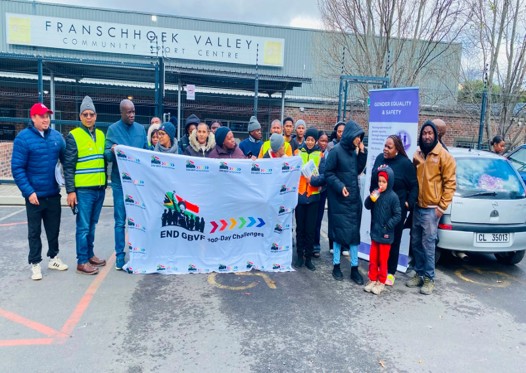
In the work to end Gender-Based Violence and Femicide (GBVF), lasting change requires fast implementation, tied in with strong community partnerships. Drakenstein Municipality embraced this philosophy, setting out to reduce the incidence of GBVF in their community by focusing on education and support. They have not only met their initial goals but have created permanent support avenues for survivors.

100 days of action: Forging a lasting legacy against GBVF in Drakenstein Read More »

How Lekwa’s 100-Day Challenge Forged a United Front Against GBV

When a community faces complex challenges like Gender-Based Violence and Femicide (GBVF), a short-term, high-intensity effort can be the catalyst for long-term change. This was the story of the 100-Day Challenge in Lekwa, where a dedicated team focused on pillar 4 of the NSP-GBVF increasing the number of support services that survivors of GBV actually receive.

How Lekwa’s 100-Day Challenge Forged a United Front Against GBV Read More »

Scroll to Top