Introduction

100-Day Challenges at a Glance

A 100-Day Challenge is a rapid, structured project designed to make significant progress on a complex strategic issue. It is not “business as usual.” It is a journey for frontline teams and leaders from different organisations to collaborate across silos, experiment with new ideas, and deliver tangible results in just 100 days.

So how are they different from traditional projects that last 100 days? And why do we believe that they enable unusually high levels of performance in teams and organisations? 

The Following Two Videos Will Help Answer the above Questions

The Secret Sauce: "Constructive Urgency"

We all know how teams pull together during a crisis: red tape vanishes, collaboration skyrockets, and everyone focuses on survival. The 100-Day Challenge is designed to replicate that high-performance energy without the actual crisis.

In a Crisis…

In a 100-Day Challenge

Natural Sense of Urgency

Artificial 100-day time frame: from project start to end

Focused attention on the issue at hand

All team members are focused on the 100-Day Goal.

“All hands are on deck “

The right people are assembled, regardless of hierarchy.

No time to get permissions and follow protocols

Team has the agency to innovate and experiment

The stakes are really high – failure can be dangerous

The 100-Day Goal is by design scary – almost impossible to achieve

The Process: Relay Race

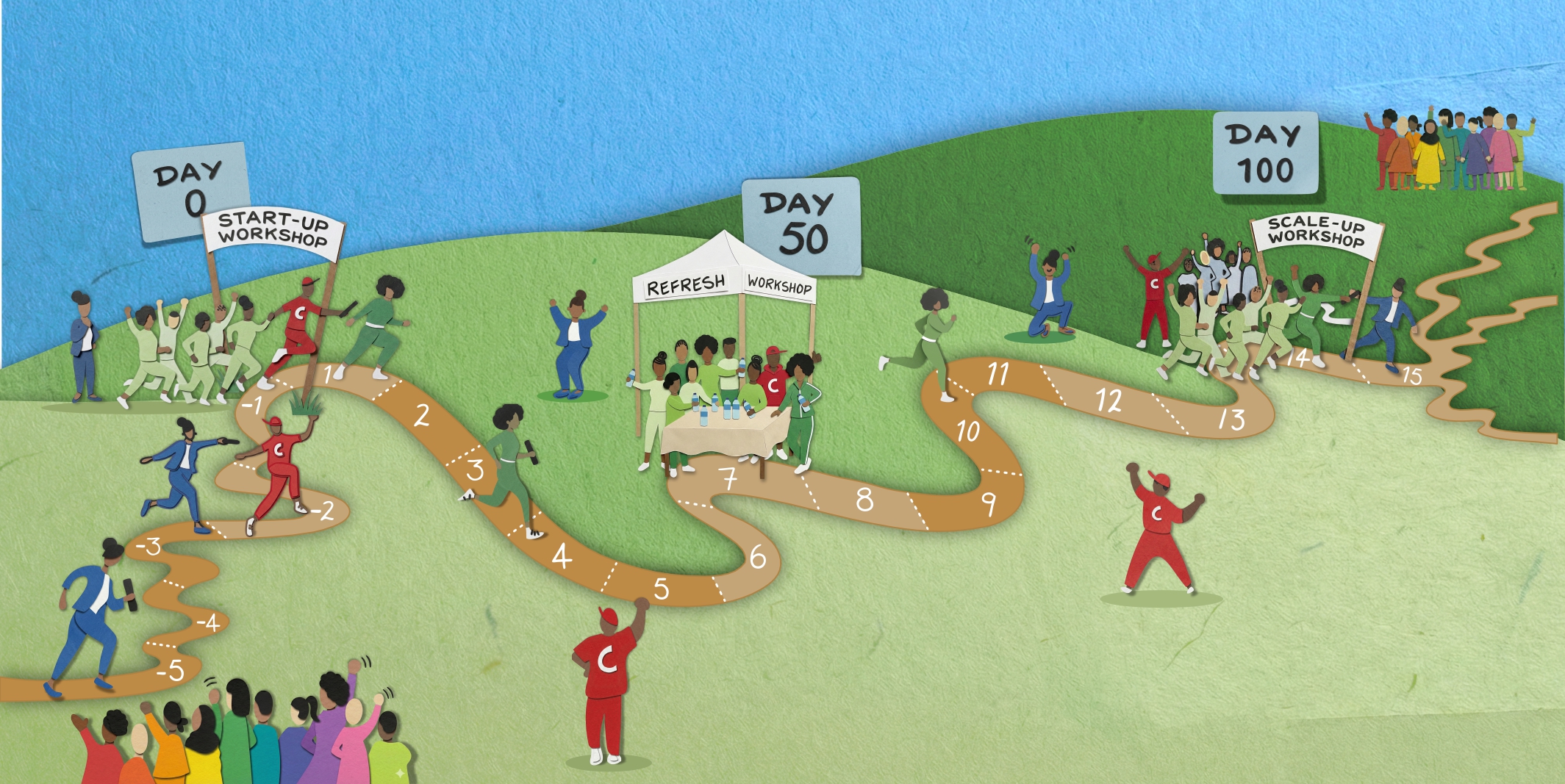
Think of the 100-Day Challenge as a relay race. The baton gets handed from one athlete to another. Unlike a typical relay race, the athletes handing over the baton don’t leave the track — they jog alongside their colleagues on the sidelines of the track to cheer, support, and clear obstacles.

Preparing the Track 
Weeks (-5) to (-3)

The Challenge Strategist, with support from Coach and in consultation with other leaders:

  • Selects focus area for the Challenge.
  • Mobilises 100-Day Team.
  • Sets the stage for the 100-Day Sprint.


Getting Starting 
Week (-2) to Day 0 

The Coach, with support from the Challenge Strategist:  

  • Helps the 100-Day Team get to the starting point (Start-up Workshop).
  • Facilitates Team discussions to set their 100-Day Goal, develop their 100-Day Plan, and shape their Team Agreement (including electing their Team Leader).
  • Coaches the Team Leader on their role. 

The 100-Day Sprint
Day 1 to 100

The Team Leader, with support from the Coach:

  • Manages weekly Team meetings
  • Keeps the Team focused on the 100-Day Goal
  • Infuses culture of collaboration, innovation, and accountability into the Team
  • Keeps the Challenge Strategist engaged

Sustain & Scale
Days 101-130

The Challenge Strategist, with support from the Coach:

  • Ensures the gains the Team made in the 100-Day Sprint are sustained.

  • Sets in motion, in consultation with other leaders, steps to build on, expand and replicate the  100-Day Challenge that was just completed.

Workshops and Beyond

There are important pauses in the Sprint (Workshops). Here’s an overview of each of these, and also the work leading up to and following the Sprint (Preparation & Amplification).

Preparation

Focus: Challenge Strategist consults with leadership stakeholders to decide on the focus of the Challenge

Team: Challenge Strategist consults with leadership stakeholders to select and recruit 100-Day Team members.

Coach: Challenge Strategist recruits Team Coach to support her and to guide the 100-Day Team

Start-Up Workshop
Day 1

Goal: The Team sets its 100-Day Goal

Plan: The Team develops its initial 100-Day Plan 

Process: The Team elects a Team Leader, and it develops a Team Operating Agreement. 

Refresh Workshop
Day 50

Goal Revisited: The Team assesses progress, and it confirms or adjusts the 100-Day Goal as needed.

Plan Adjusted: The Team adjusts its 100-Day Plan for the remainder of the race.

Team Dynamics: The Team assesses its own dynamics, and it adjusts the Team Operating Agreement as needed.

Scale-up Workshop
Day 100 

Celebrate: The Team celebrates achievements and shares lessons learned

Sustain: The Team recommends ways to sustain the impact

Amplify: The Team and leaders map out options to build on the 100-Day Challenge

Amplification

Path Forward:  Challenge Strategist & Team Coach help leadership stakeholders decide on the path forward  

Governance: Leadership stakeholders, guided by the Challenge Strategist, recruit Challenge Strategists and Team Coaches to guide and support future 100-Day Challenges and other related projects. 

The Key Players

Leadership Stakeholders

Leadership Stakeholders are senior representatives in the organisation and the local eco-systems engaged in the issue at hand. They commission the Challenge. They define the “what” (the focus area) and clear the path for the Team. 

Challenge Strategist

The Challenge Strategist provides the inspiration and energy to bring 100-Day Challenges to life and put 100-Day Team on the right track for their Sprint. They practice “confident humility”—leading by empowering others.

Team Coach

The “Guide.” They support the Strategist to prepare for the track for the Sprint, manage the Start of the Sprint, and coach the Team Leader during the Sprint. They facilitate the workshops and keep the process on track.

Often, two Coaches support a 100-Day Challenge. Typically, one focuses on supporting leadership stakeholders, such as the Challenge Strategist, and the other focuses on supporting the Team, including the Team Leader. The two can support and fill in for each other as needed.

Team Leader

Elected by the team during the Start-up Workshop,  The Team Leader keeps the Team focused on the 100-Day Goal and managed the Team energy and the 100-Day Plan.

100-Day Team

A cross-functional group of “doers” who operate outside normal hierarchies. They have full agency to experiment and find a way to the 100-Day Goal.

They use weekly team meetings to remain focused on the Goal, review progress against the 100-Day Plan, and support each other.  

Three Hallmarks of Successful 100-Day Challenges

Successful 100-Day Challenges deliver three things:

Performance Increases

Dramatic performance increases are inspired by an unreasonably ambitious 100-Day Goal.

Insight about System Patterns

Insight about system patterns that enable or limit performance. These insights result in shifts in the systems, which leaders embed and amplify in post-100-day actions.

Transformative Experience

The experience transforms the people. They gain confidence, leaders learn to trust, and the organisation or system builds a muscle for agile collaboration.

Beyond the 100-Day: What's Next?

The 100-Day Challenge is just the start. Once the team crosses the finish line, the organisation chooses one of three paths to sustain the momentum:

The Reset Path

The same team runs another 100 days on the same issue to consolidate gains or hit a higher target.

The Build Path

A new team is formed to tackle a different, related issue that emerged during the first sprint.

The Scale Path

The solution works! Now, new teams in different locations (e.g., other municipalities or courts) run their own challenges to replicate the success.

Proven Results

Our own 100-Day Challenge Guru – Nadim (the young version) talking about doing 100-Day Challenges in different countries. (100-Day Challenge used to be called Rapid Results Initiatives)

Chief Prosecutor for the Polokwane Cluster, Octavia,  shares some insight into the impact of the End GBVF 100-Day Challenges in the courts and how the experience has influenced the way of working to improve the reporting and management of GBVF cases in courts.

Managing Director and Ops Manager at various international mining companies including Chile and Australia, Mia, uses 100-Day Challenges, which was called Rapid Results in the past, to enable the operations to utilise and harness the front-line teams’ capacities to implement and innovate.

Ready to Start?

You are joining a global community of coaches and leaders who are not just managing projects — they are changing systems.
Scroll to Top